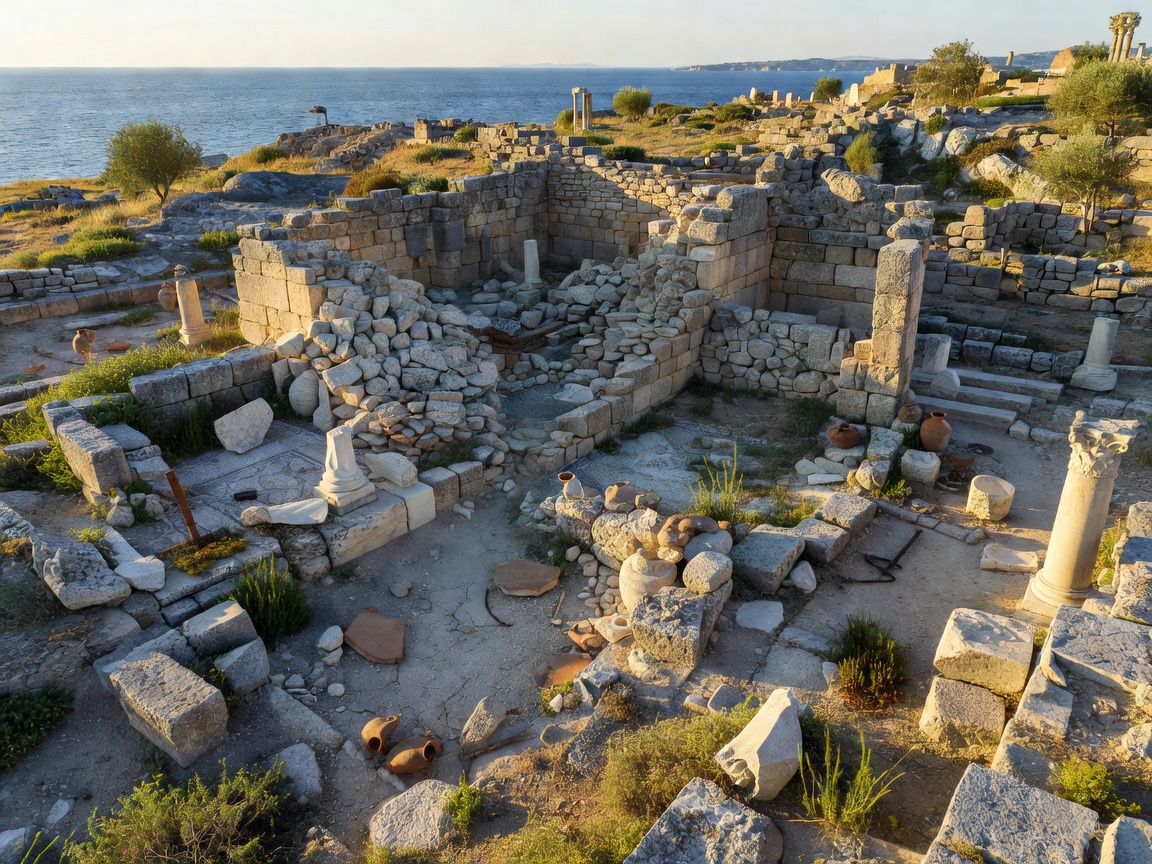
From prehistoric evidence to written histories
“Ancient Europe” is a useful course label, not the name of a unified ancient culture. It can include communities that left no written records, societies connected to the Mediterranean, and political formations that changed across centuries. Prehistoric study often depends on material evidence: settlements, burials, tools, environmental remains and landscapes. Interpretations can change as methods and evidence develop. A course should make clear which regions and periods it includes.
From the second millennium BCE, the eastern Mediterranean connected communities through movement, exchange and political contact. The Aegean world included palace societies and later communities organized in different ways. Greek-speaking city-states were not a single state. Athens, Sparta and other poleis had distinct institutions and social arrangements. Greek communities also formed colonies around the Mediterranean and Black Sea. Colonization, trade and migration created contact; they did not erase local societies.
Greek worlds and Roman expansion
Greek political history asks how communities governed, made alliances and fought wars. Social history asks how status, gender, household, labor and citizenship shaped daily life. Citizenship was limited and varied by place. In many city-states, women, enslaved people and resident foreigners did not hold the same political rights as citizen men. Courses that define their scope only through political leaders may leave these experiences at the margins.
Rome developed from a city-state into a republic and then an imperial system. Roman expansion across Italy and the Mediterranean altered military organization, taxation, law and political authority. The Republic’s institutions did not simply disappear at one instant; power accumulated and changed through conflict. Augustus established a durable form of one-man rule while retaining republican language and offices. Later emperors governed a large, diverse territory through provincial administration, armies, local elites and negotiated relationships.
Roman rule did not make every province alike. Local languages, customs and institutions persisted, while roads, ports, markets, armies and administrative structures connected distant places. The western imperial government fragmented in the fifth century CE. The eastern Roman Empire continued for centuries. Courses that treat 476 CE as a clean end to Roman history simplify a longer and regionally uneven transformation.
Trade, religion and cultural exchange
Trade linked agricultural producers, craftspeople, ports and consumers. Grain, metals, pottery, textiles and other goods moved through routes that changed over time. Economic history examines production, labor, taxation and exchange rather than treating commerce as background. Archaeological evidence can reveal objects and settlement patterns, but an object’s presence alone does not prove exactly how or why it moved.
Religious life was varied. Greek and Roman practices included civic rites, household observances, sanctuaries and local cults. Jewish communities were present across the Mediterranean. Christianity emerged in the Roman world and gained imperial support in the fourth century. Religious change was gradual and uneven. A useful course distinguishes official policy from lived practice and avoids projecting later religious boundaries unchanged into antiquity.
Five lenses for reading a course
- Political history: institutions, rulers, citizenship, war and state formation.
- Social history: households, status, gender, labor and the lives of non-elites.
- Archaeology: objects, buildings, landscapes, burials and settlement evidence.
- Economic history: agriculture, production, trade, taxation and labor systems.
- Cultural history: religion, education, art, language and shared practices.
The lenses overlap. A study of a port city, for example, can connect trade routes with migration, religious practice, architecture and political control. Check whether a course explains how it combines evidence and what its sources cannot establish.
Regional comparisons and interpretation
Mediterranean histories are important, but they are not the whole of ancient Europe. The Black Sea, Atlantic coast, northern landscapes and central European river systems had their own communities and patterns of contact. Archaeological evidence is uneven. Written records often survive because powerful institutions produced or preserved them. This creates a risk: literate elites can appear more representative than they were. Comparison works best when it identifies what is being compared and avoids forcing unrelated societies into one model.
Courses also differ in their treatment of slavery, imperial power and cultural exchange. Roman infrastructure and law had enduring effects, but neither should be used to excuse conquest or to suggest that all later European institutions descend directly from Rome. Continuity and change need evidence. Ask whether a course separates ancient self-understanding from later uses of antiquity.
Why study this period?
Ancient history offers a long view of political organization, urban life, citizenship, empire and cultural contact. It also trains close reading across different evidence types. Material remains can complement written accounts and expose gaps in elite narratives. The period is useful for comparison, provided modern political categories are not projected backward as if they were timeless.
Good For
Choose this route if you want to compare Greek and Roman institutions, follow Mediterranean exchange, explore archaeology, or study how societies organized labor, religion and political membership. Introductory courses may suit learners new to ancient chronology. Source-focused courses suit readers ready to work with translated texts and material evidence.
What To Check
- Does the date range include prehistory, classical antiquity, late antiquity or only part of these?
- Which regions are covered beyond Greece and Rome?
- Are archaeological sources explained alongside written evidence?
- How does the course address slavery, gender, citizenship and imperial rule?
- Does it distinguish evidence from later tradition and modern interpretation?
Course selection criteria
Compare academic level, chronology, geographic scope and thematic focus. Check whether the course is chronological or organized around questions such as empire, religion or trade. Look for explicit work with primary sources, clear definitions of key terms and discussion of source limitations. A broad survey offers orientation; a regional or thematic course may provide more depth. Neither format is automatically better. Choose according to the question you want to pursue.
Related guides
Follow changes in political and religious authority with Medieval Europe. For later debates about classical learning and religious change, see Renaissance & Reformation.
Need help navigating the guides?
Send a question or report an issue through the contact page.
Contact the site